A survey report is only as good as the way its readings were taken. For each of the 14 instruments we use on site, here is what it measures, what it finds, how it appears in the report, and its limit.
Hull
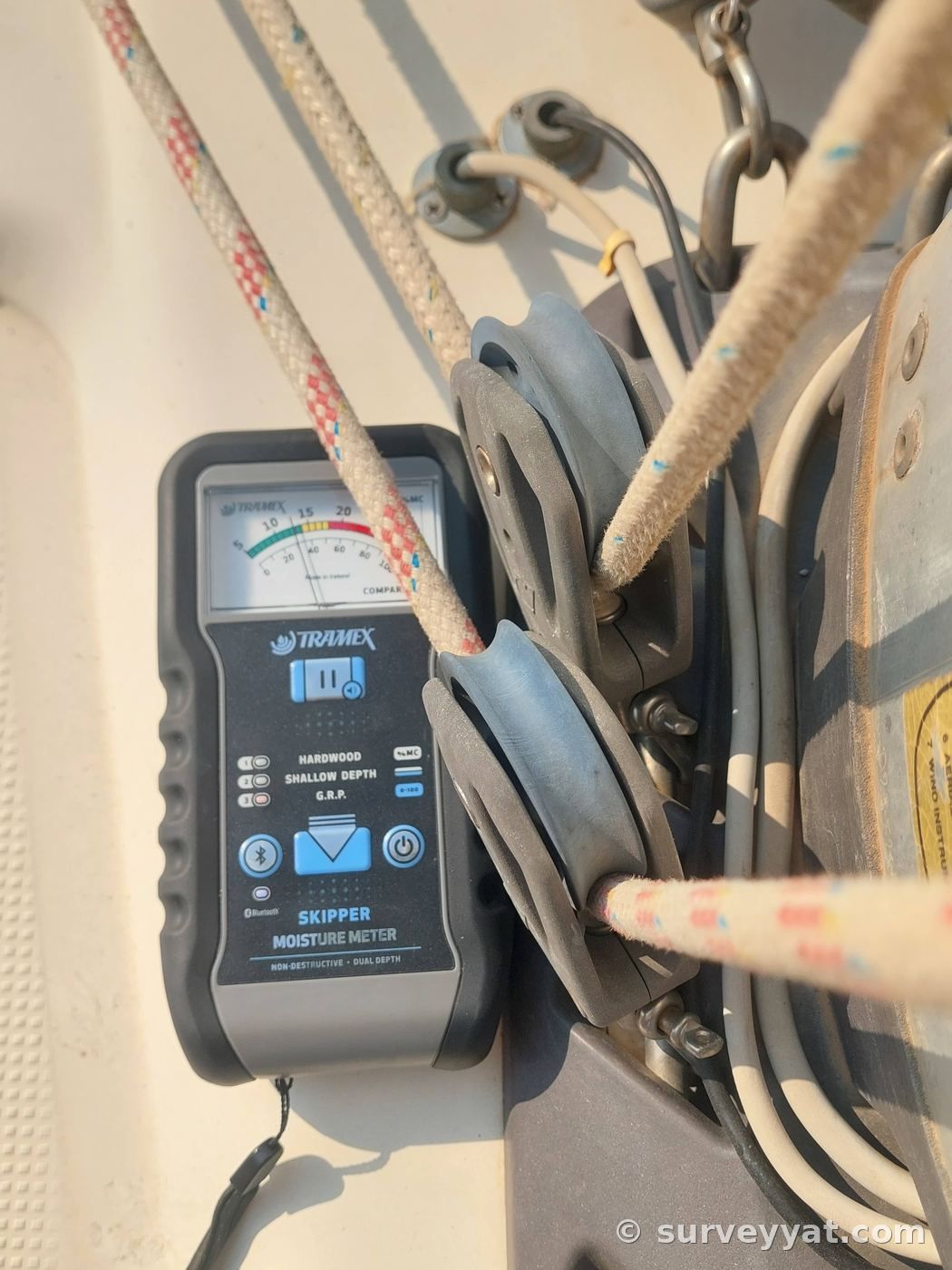
Tramex Skipper Plus moisture meter
- What it measures
- Reads moisture in laminate comparatively, sending its signal in from the surface.
- What it finds
- Wet sandwich core, moisture build-up ahead of osmosis, and water tracking in around deck fittings.
- How it appears in the report
- Readings across a grid on the hull are shown as a moisture map beside a reference area taken as dry.
- Its limit
- Readings are comparative, not absolute. The boat must have been ashore and dry for at least one week; metal, carbon and copper-based antifouling distort the reading.

Hull
Phenolic sounding hammer
- What it measures
- Compares the ring of the laminate when it is tapped lightly.
- What it finds
- Delamination, core separating from the skin, and voids within the laminate.
- How it appears in the report
- Areas that sound dull are marked on the hull sketch and read together with the moisture map.
- Its limit
- The sound needs interpreting; in very thick laminate a deep defect may not be heard, which is why it is used with moisture readings.

Hull
UNI-T ultrasonic thickness gauge
- What it measures
- Measures the remaining thickness of steel and aluminium plate with sound waves.
- What it finds
- Plate thinned by corrosion, especially in the bilge, at the waterline and around welds.
- How it appears in the report
- Point readings are shown on a zone sketch with percentage loss against original thickness and a list of the thinnest points.
- Its limit
- It reports only the point measured and needs surface preparation and couplant. Used on steel and aluminium boats.
Electrical and engine
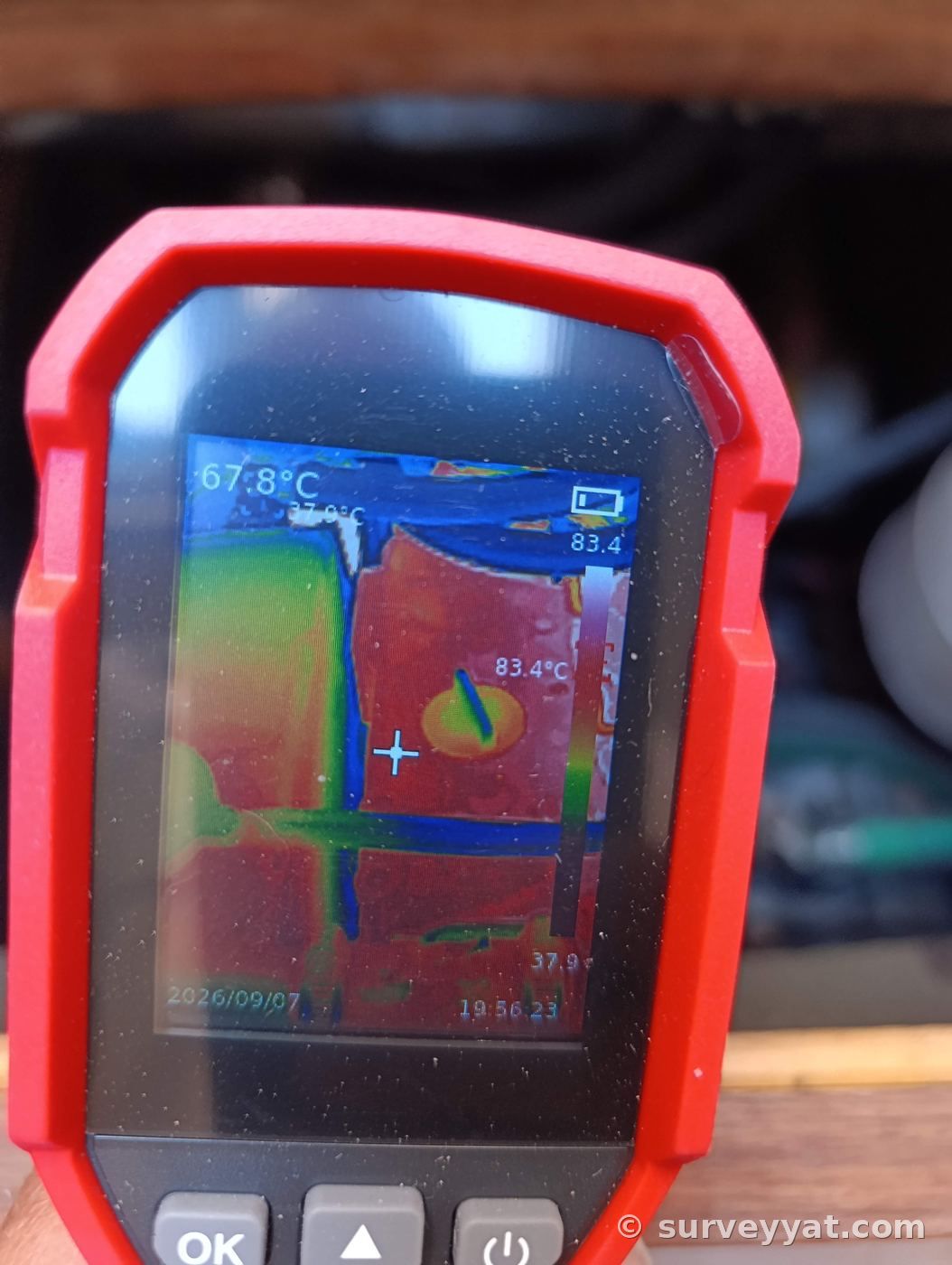
Thermal camera
- What it measures
- Shows the temperature distribution of surfaces as an image.
- What it finds
- Hot electrical connections, overheating pumps and bearings, and cooling or exhaust lines starting to block.
- How it appears in the report
- The thermal image is shown beside a normal photo from the same angle, with the temperature.
- Its limit
- It shows surface temperature and needs the system running under load to mean anything. Shiny metal can read falsely.

General
Borescope camera
- What it measures
- Looks inside closed spaces the eye cannot reach, through a slim camera head.
- What it finds
- Leak marks behind linings, corrosion in closed compartments and debris in bilge recesses.
- How it appears in the report
- Images are placed with the finding, with the location noted.
- Its limit
- It enters through an existing opening; nothing is dismantled for it and engines are not opened.

Electrical
UNI-T True RMS clamp meter
- What it measures
- Measures AC and DC current without breaking the cable; being True RMS, it reads inverter and generator current correctly.
- What it finds
- Batteries not charging, weak alternator and charger output, leakage current and overloaded circuits.
- How it appears in the report
- Charge, consumption and leakage readings are listed in a table by circuit.
- Its limit
- It measures with the circuit live and gives the value at that moment; intermittent faults need longer logging.
Electrical
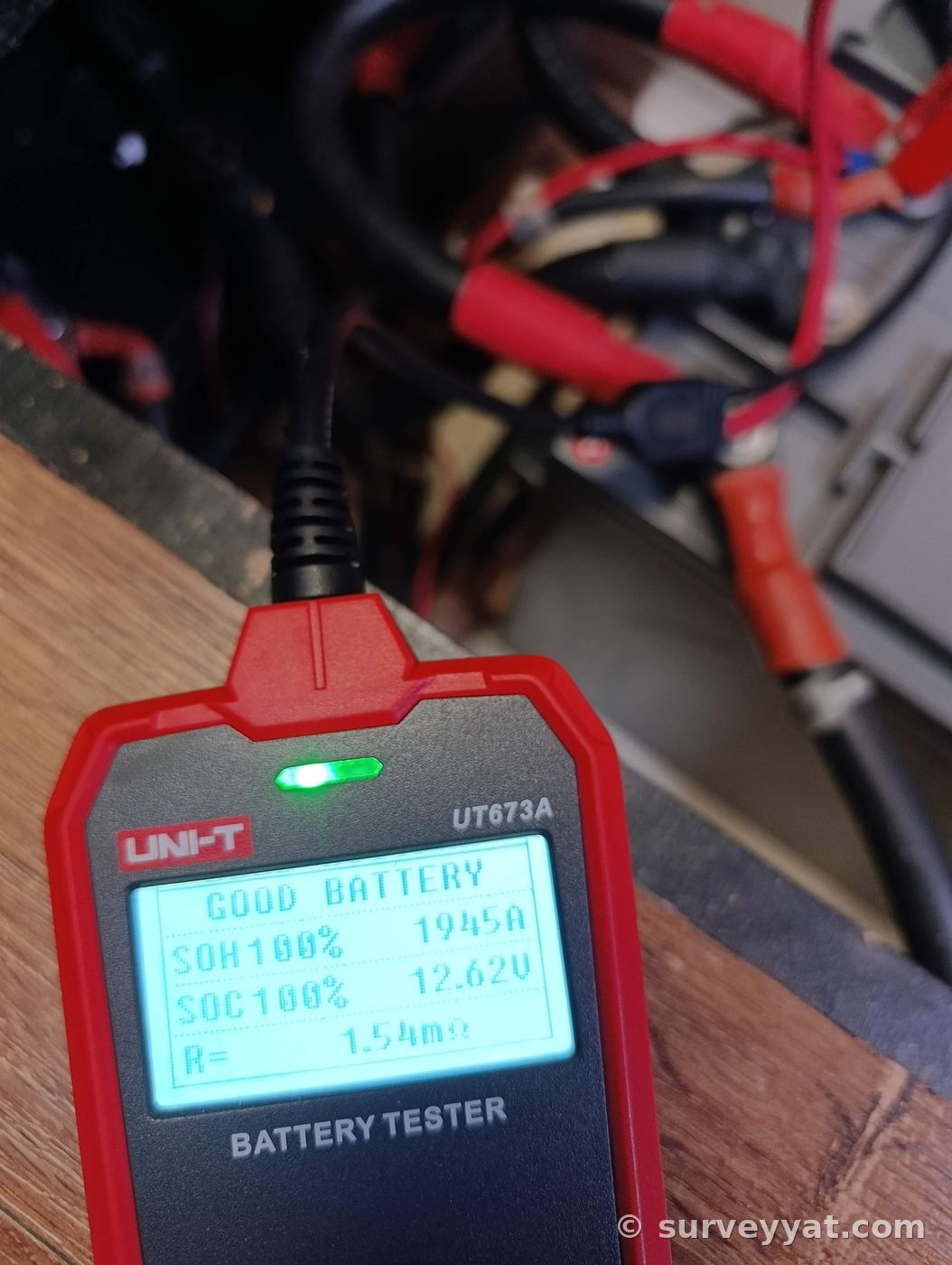
Battery tester
- What it measures
- Measures internal resistance and cranking capacity of lead-acid and AGM batteries.
- What it finds
- Batteries whose voltage looks normal but whose capacity has gone.
- How it appears in the report
- Each battery's reading is listed against its rated value.
- Its limit
- The battery must be charged. On lithium banks, condition is read from the battery management system (BMS) records.

Corrosion
Zinc reference electrode
- What it measures
- Measures, through the water, the protection potential of the boat's underwater metals in millivolts.
- What it finds
- Undersized or spent anodes, over-protection, and corrosion risk from stray current.
- How it appears in the report
- The value for each bonded metal is shown against the range it should be in for that material.
- Its limit
- It is done with the boat afloat and shows conditions at that moment; readings are taken with shore power on and off.

Rig
Loos & Co. rig tension gauge
- What it measures
- Measures shroud and stay tension on the scale matched to wire diameter.
- What it finds
- Slack or over-tight rigging and port-starboard imbalance.
- How it appears in the report
- Each wire's tension is tabled with its ratio to breaking load.
- Its limit
- It measures tension, not internal fatigue of the wire. The masthead is inspected separately; rod rigging needs a different method.
Engine and shaft
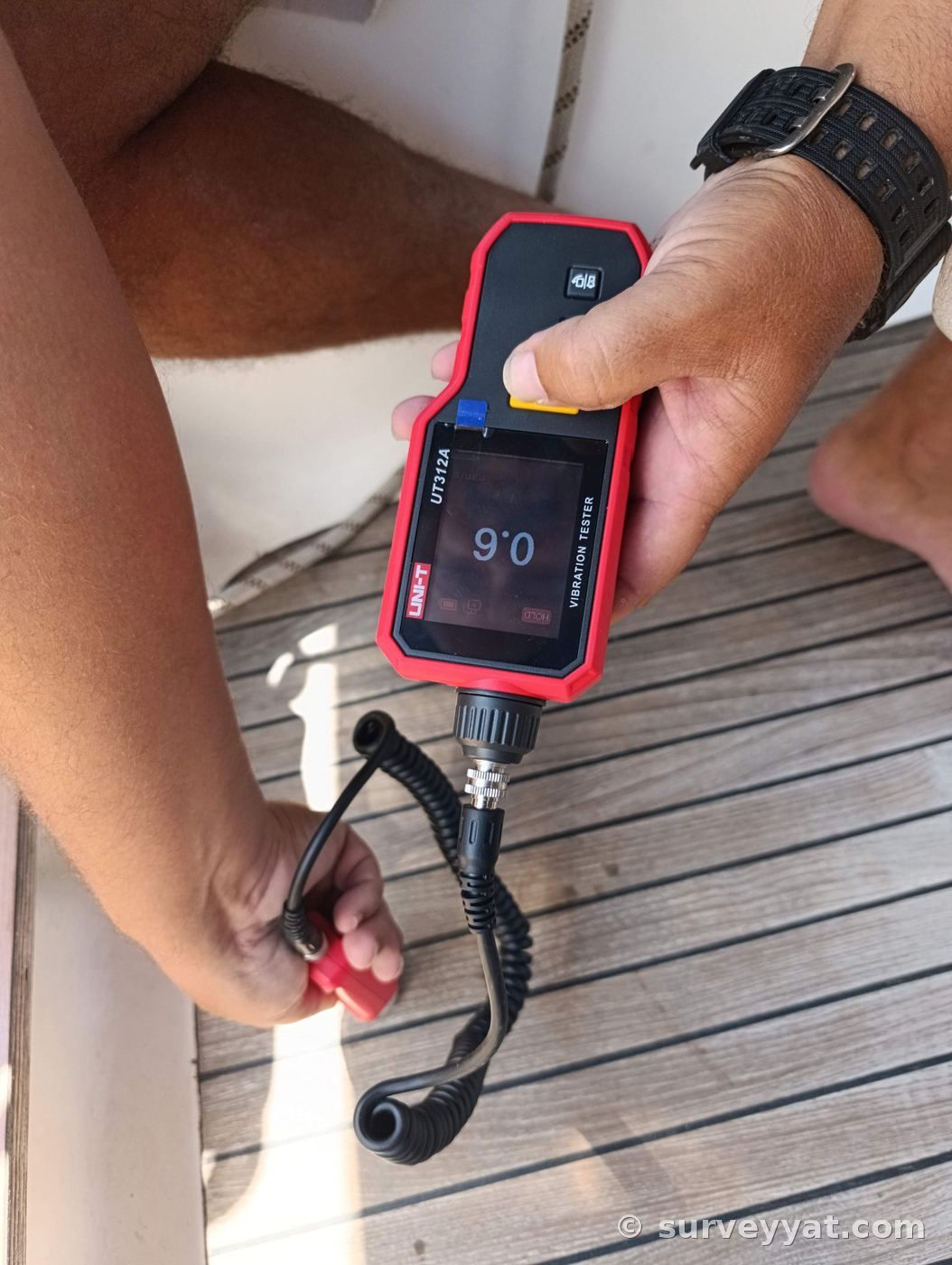
Vibration meter
- What it measures
- Measures vibration in engine, gearbox and shaft line against rpm.
- What it finds
- Shaft misalignment, collapsed engine mounts and signs of propeller imbalance.
- How it appears in the report
- Vibration values at each rpm step are shown in a table.
- Its limit
- It shows whether vibration is present and how large; separating the source takes interpretation. Precise alignment is a separate mechanical job.
Engine and comfort
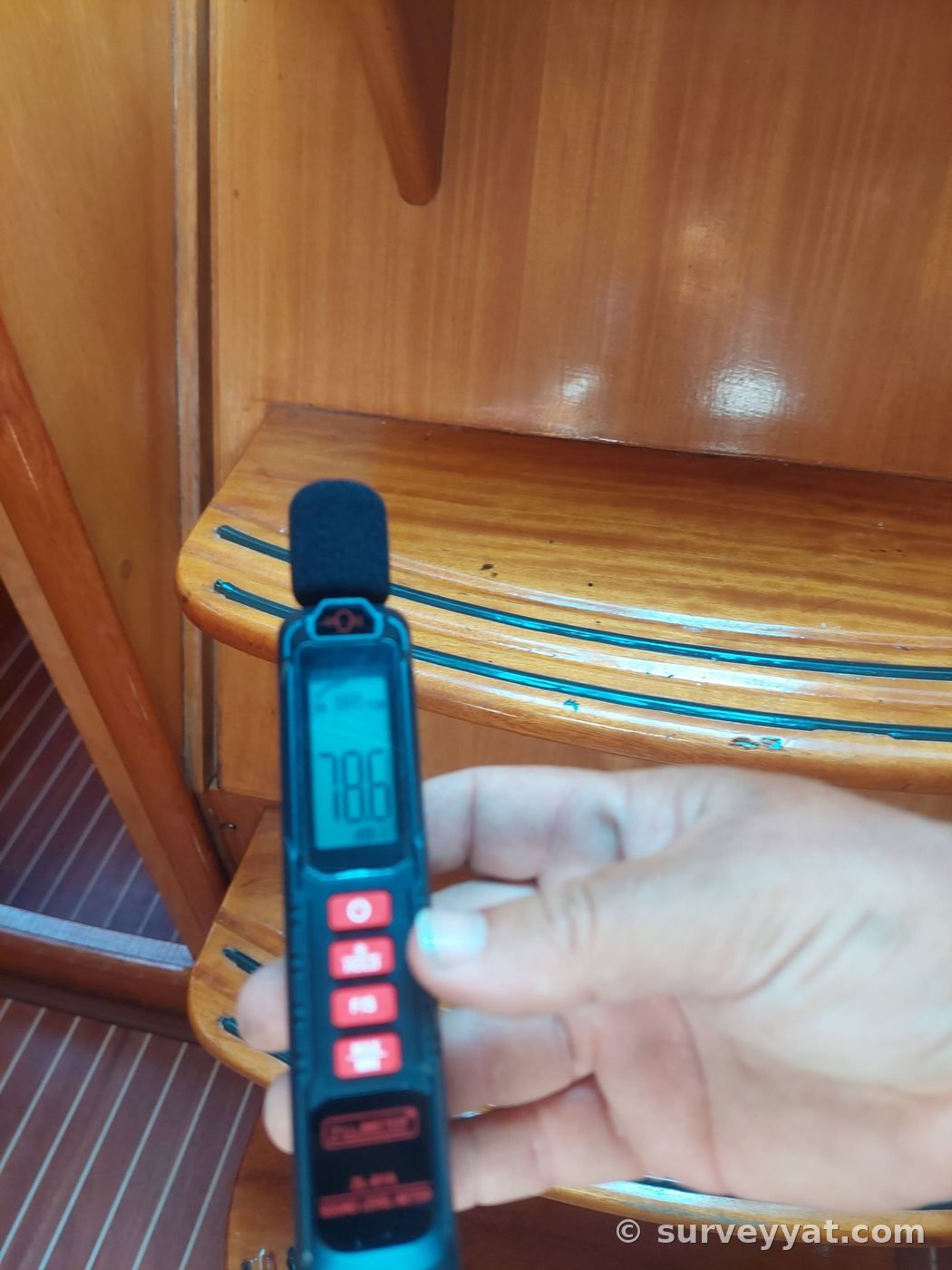
Sound level meter
- What it measures
- Measures noise in the accommodation and around the engine room in decibels.
- What it finds
- Degraded engine room insulation and unusual exhaust or hull-borne noise.
- How it appears in the report
- dB values in cabins and saloon are given by rpm.
- Its limit
- It is for comparison; ambient noise and sea state affect the value.

Engine
Infrared thermometer
- What it measures
- Measures the surface temperature of a single point without contact.
- What it finds
- A hot exhaust elbow, gearbox and alternator temperature, and the in-out difference across the cooling circuit.
- How it appears in the report
- Temperatures taken at set rpm during the sea trial are shown in a table.
- Its limit
- It measures the surface and can misread on shiny metal. Used together with the thermal camera.

General
Laser distance meter
- What it measures
- Measures distances and dimensions precisely.
- What it finds
- Differences between documented dimensions and the boat; tank, compartment and hatch sizes.
- How it appears in the report
- Measured dimensions are shown against documented values in the relevant section.
- Its limit
- Length overall and registered length are defined differently; the comparison allows for this.

Hull and rig
30× loupe
- What it measures
- Magnifies fine surface detail thirty times.
- What it finds
- Hairline gelcoat cracks, osmosis blisters, hairline cracks in rigging terminals and broken wire strands.
- How it appears in the report
- The finding is shown in a close-up photo with its location.
- Its limit
- It shows the surface only; crack depth needs another method.
How the gas system is checked
The LPG system on board is checked step by step along the line, not by reading an instrument display:
- Gas locker: the locker is checked to be gas-tight, with its drain open and above the waterline.
- Hoses and joints: hose manufacture dates, flexibility and clamps are inspected; joints are checked one by one with a leak-detection solution.
- Solenoid valve and control: the valve is tested opening and closing from its switch.
- Cooker and flame failure device: the device that cuts gas when the flame goes out is tested.
- Ventilation: ventilation of the galley and carbon monoxide risk are assessed.
Where a pressure-drop test on the line is needed, it is coordinated with a qualified gas fitter and reported in its own section.
Scope: The survey is non-destructive and nothing is dismantled; details on the survey types page.
Continue with this topic
- Borescope: engine and tank interiors: What is done on the survey and as a separate service.
- Reading the measurements: Moisture readings and sounding on their own pages.
Laboratory: oil analysis
Alongside the instruments we use on site, a laboratory oil analysis can be added to a survey for the internal condition of engines and generators. More: oil analysis.