Why the battery system is critical
At anchor everything, lights, pumps, fridge, navigation electronics, runs off the battery bank. A tired or badly installed system leaves you stranded at anchor and can be a fire risk. Lithium (LiFePO4) banks are now common, and when installed wrongly they are a serious hazard. So the battery and charging system is assessed separately before purchase.
What we check
- Bank condition and type: flooded, gel, AGM or lithium; age, swelling, corrosion, capacity loss.
- Charging sources: alternator, charger, solar and inverter, all matched to the battery type.
- Lithium safety: battery management system (BMS), correct charge profile, over-current protection, wrong installs are a fire risk.
- Wiring and fuses: cable size, tightness, main fuse and isolators; thermal camera for heat under load.
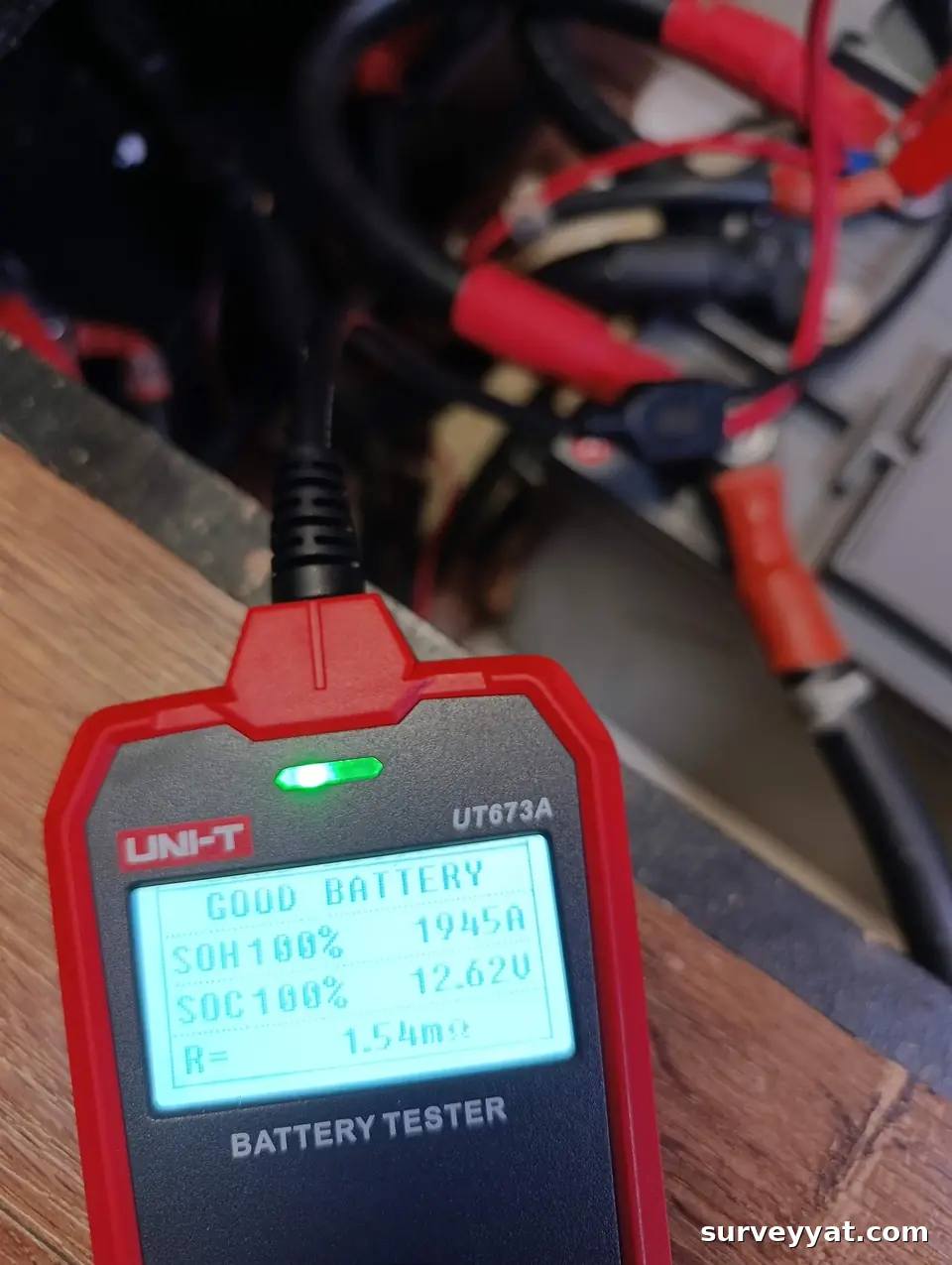
- Battery test: bank condition measured with a tester; voltage drop observed under draw.
Buying a boat converted to lithium
The most common fault on boats converted to lithium is that the conversion was not matched to the alternator and charger, which burns both the battery and the alternator. The survey shows whether the conversion is correct and the BMS works. Take it with the electrical survey for a fuller picture.
Is the battery bank big enough? A simple sum
Whether a bank is big enough is judged against daily consumption. Multiply each item's current (amps) by hours used per day and add them up: that is your daily amp-hour (Ah) need.
Example: fridge 4 A × 12 h = 48 Ah, instruments and autopilot 5 A × 8 h = 40 Ah, lights and the rest 20 Ah → about 108 Ah a day.
- With lead-acid, gel and AGM, using much more than about half the capacity shortens life; this example needs at least ~220 Ah nominal.
- Lithium allows deeper use, so a smaller bank can do the job, but the charging system must suit lithium.
On survey the measured capacity is compared with the label; an ageing bank can be far below it.
Telling a battery's age
The date code on the case or the purchase invoice gives the age. Service life in marine use depends heavily on how batteries are used and charged. On survey, age is weighed with resting voltage, voltage drop under load and internal resistance from a battery tester; we also check for batteries of mixed ages in one bank.
FAQ
Is battery check included?
Yes, the bank and charging system condition is part of the pre-purchase survey, using a battery tester and thermal camera.
Do you check whether a lithium bank is safe?
We assess install suitability (BMS, charge profile, protection) and record it. Cell-level health may need a manufacturer service test; we note this.
Related
Electrical survey · Generator survey · Navigation electronics