This page shows example finding records taken from real reports. Vessel identity, owner details and location have been removed; the language of the findings, the classification and the costing approach are exactly as issued. The point is to let you see the tone and seriousness of the report before you pay for one.
1. Identification Page (example)
| Report no | SY-2026-0xx |
|---|---|
| Date / place | ., .2026 · [marina], ashore and afloat |
| Scope | Pre-purchase, ashore + sea trial |
| Vessel | [Builder / model], [year], LOA, m, LWL, m, draught, m |
| Hull / HIN | GRP · HIN verified · CE category B |
| Machinery | [Make], HP, hours (indicated), serial verified |
| Drying period | 8 days ashore, uncovered (sufficient for moisture readings) |
| Present | Surveyor, buyer, marina technician |
2. Executive Summary (example)
The vessel is assessed as well maintained for its age. No structural defect was identified and hull moisture readings are consistent with the dry reference area. There are four class A findings to be rectified before going to sea, all safety items (seacocks, bilge float switch, exhaust hose age, liferaft service). Estimated total for these: €1,400-2,300.
Nine class B findings are recommended within the first season, estimated at €3,200-5,800 in total. The standing rigging is 11 years old; no cracking was found at the terminals, but the age should be expected to attract questions at insurance renewal.
Opinion: with the class A items rectified the vessel can be used safely. Raising the class A total, together with part of class B, is reasonable in negotiation.
3. Finding Records (example, redacted)
A-03 · Engine room, starboard seacock
| Observation | Chalking (dezincification) on the bronze body; the lever is stiff. A single clamp is fitted on the hose at the outlet; the hose is hardened with surface cracking. |
|---|---|
| Assessment | Dezincification is the loss of zinc from the bronze alloy and leaves the fitting liable to sudden failure. Double clamping is standard on every hose below the waterline (ABYC H-27 approach). |
| Class | A, critical / flooding risk |
| Recommendation | Renew valve and hose; convert all below-waterline hoses to double clamps. |
| Estimate | €250-450 (labour included, ashore) |
| Photographs | Figs. 14-15 (valve body and hose connection) |
B-07 · Hull, moisture readings, port quarter
| Observation | Against the dry reference area (forward shoulder, average 8), six points on the port quarter read 14-18 on the same comparative scale. No blistering or gelcoat breakdown observed. The vessel had dried ashore for at least a week before reading. |
|---|---|
| Assessment | A local and limited elevation; not evidence of widespread saturation or osmosis. Proximity to the shaft and stern tube should be taken into account. |
| Class | B, short term / monitor |
| Recommendation | Re-read the same points at the next haul-out; investigate beneath the gelcoat if values rise. |
| Estimate | Monitoring: no cost · investigation if required €400-900 |
B-11 · Rig, starboard cap shroud terminal
| Observation | No cracking found at the swage exit under 30× magnification; light corrosion staining present. Loos readings: starboard cap 28, port 24 units, a 15% imbalance. |
|---|---|
| Assessment | Uneven tension pushes the mast out of column; the boat behaves differently on each tack and the chainplate area carries asymmetric load. The rig is 11 years old. |
| Class | B, short term |
| Recommendation | Tune the rig and record the tensions. Expect the rig age to be questioned at insurance renewal. |
| Estimate | Tuning €150-300 · full re-rig (in due course) €4,000-8,000 |
C-02 · Information, generator hours against engine hours
| Observation | Main engine 1,240 hours; generator 2,980 hours. |
|---|---|
| Assessment | A generator running at twice the main engine's hours indicates a vessel used mainly at anchor or on the berth. Not a defect; the maintenance plan should be built around that profile. |
| Class | C, monitor |
4. Recorded Readings (example)
| Reading | Value | Note |
|---|---|---|
| Maximum revolutions (trial) | 3,150 rpm | Builder states 3,200-3,400, propeller/fouling check advised |
| Cruise revolutions / speed | 2,400 rpm · 7.4 knots | |
| Engine temperature (under load) | 82 °C, stable | Within normal range |
| Oil pressure (2,400 rpm) | 3.8 bar | Within normal range |
| Charging current / voltage | 42 A · 14.1 V | Alternator and regulator functioning |
| Hull moisture (dry reference) | 8 average (comparative scale) | Forward shoulder, after a week of drying |
| Cathodic protection potential | Within target band | Anode consumption normal |
| Vibration (2,400 rpm) | Low, proportional to revs | Shaft alignment satisfactory |
C-12 · Engine, raw-water pump impeller
| Observation | Impeller in place and functioning; early permanent deformation of the vanes observed. No replacement date in the service records. |
|---|---|
| Assessment | Impellers have a service life and a shed vane blocks the heat exchanger. Not a defect, a periodic maintenance item now due. |
| Class | C, Planned maintenance |
| Recommendation | Replace at the start of the season; keep a spare impeller aboard. |
| Estimate | €60-120 |
| Photograph | Fig. 26 (pump cover open) |
Pages from a real report
What the structure above looks like in practice: selected pages from one of our recent pre-purchase survey reports. Tap an image to enlarge.
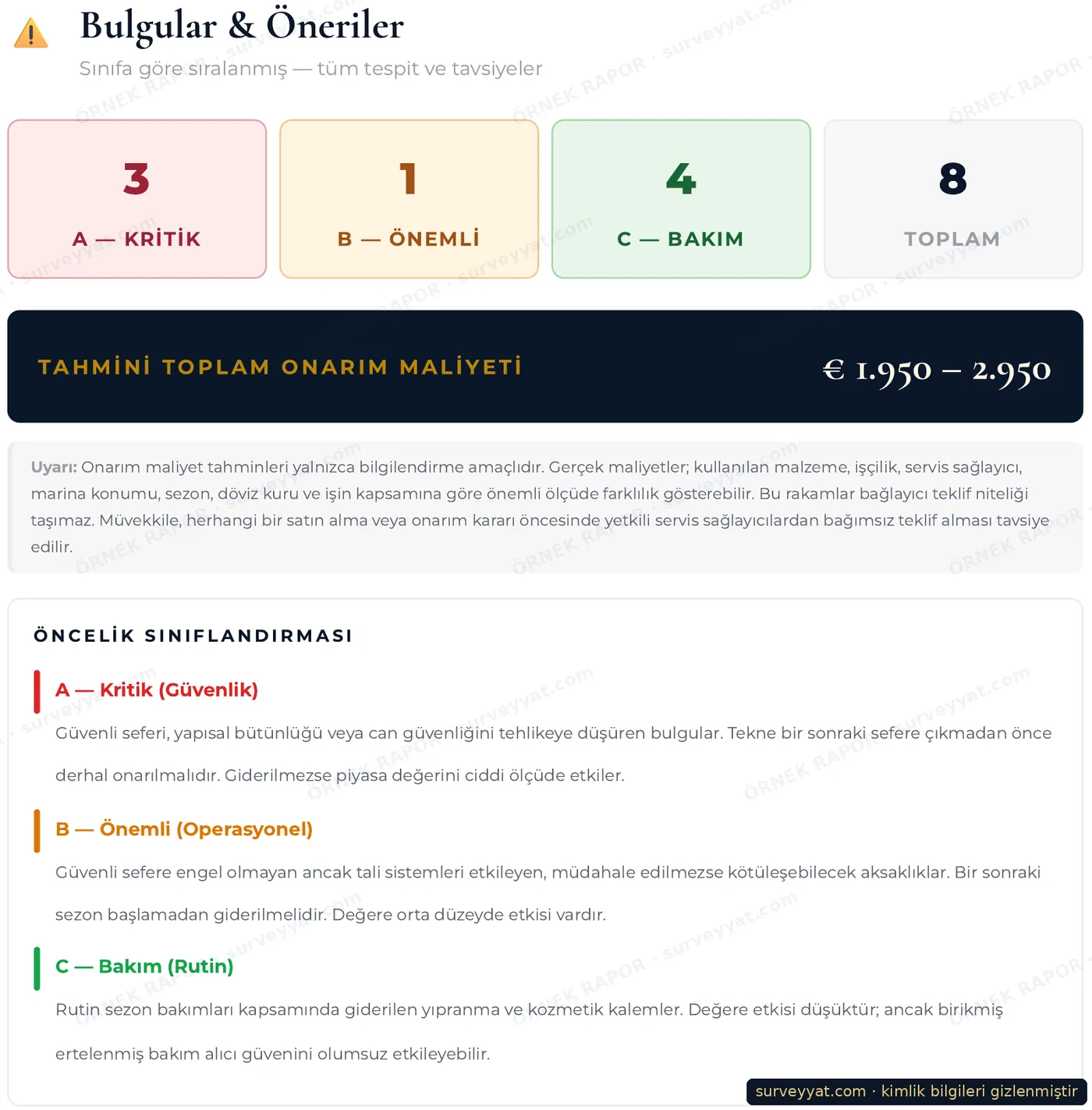
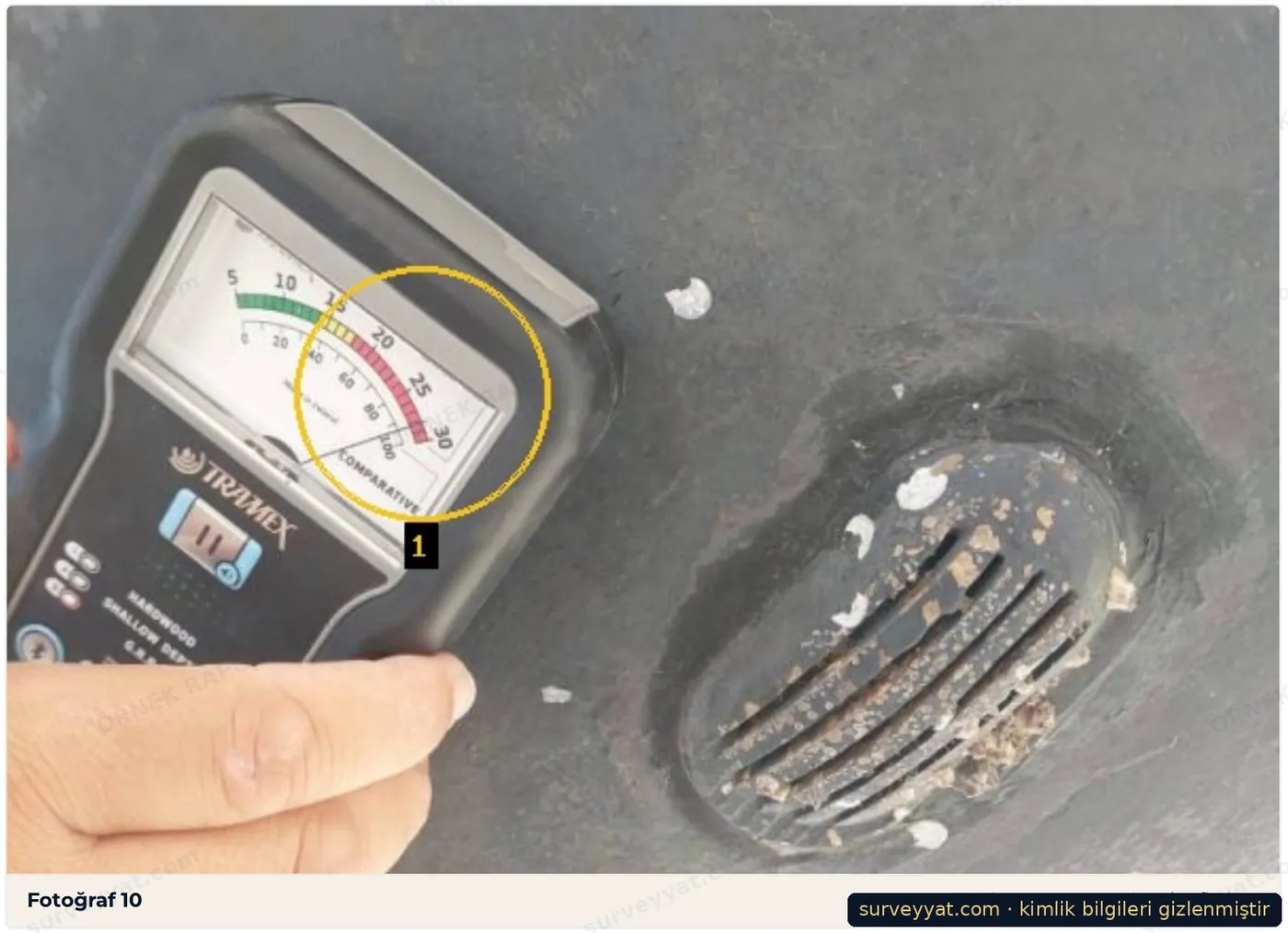
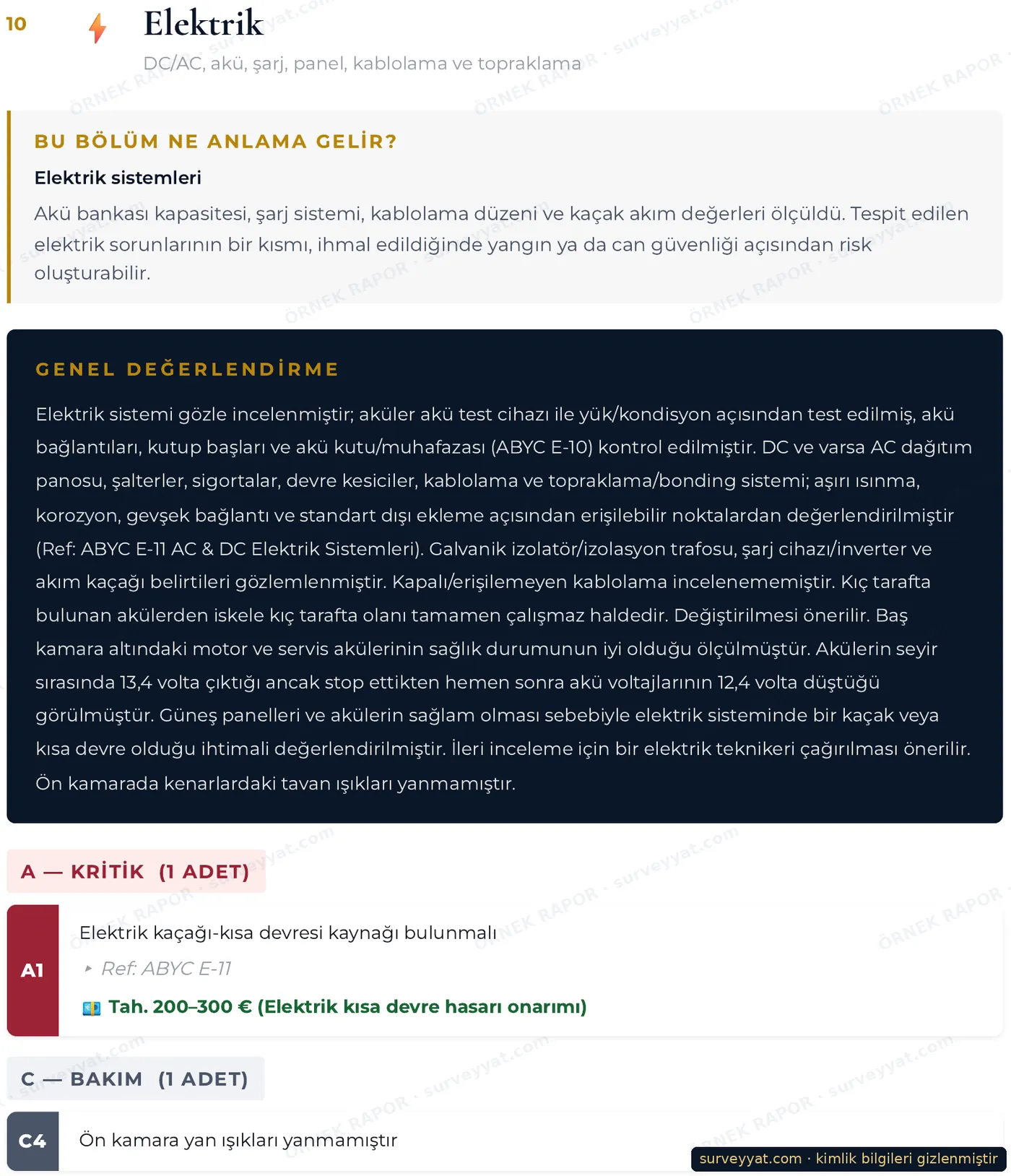
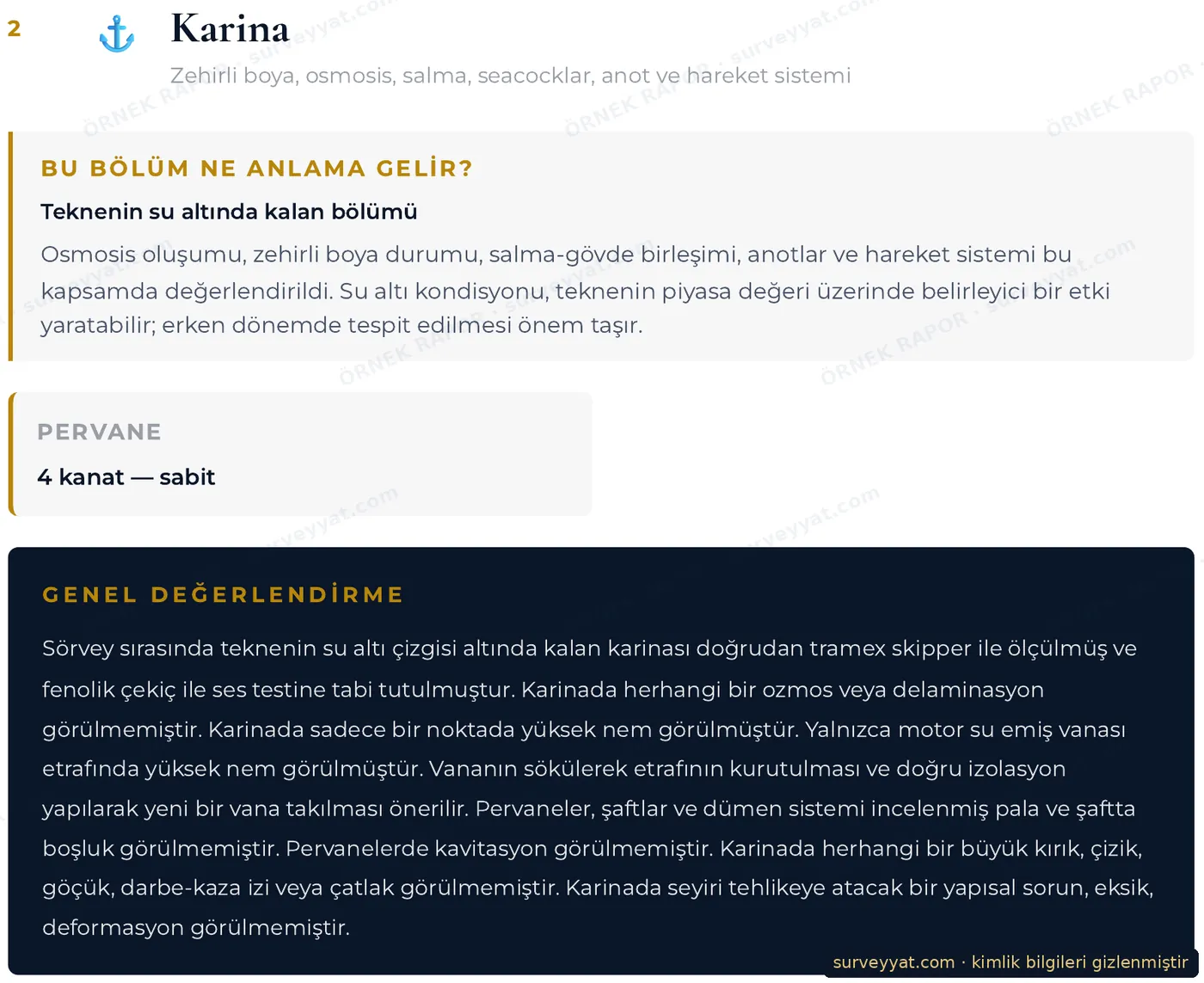
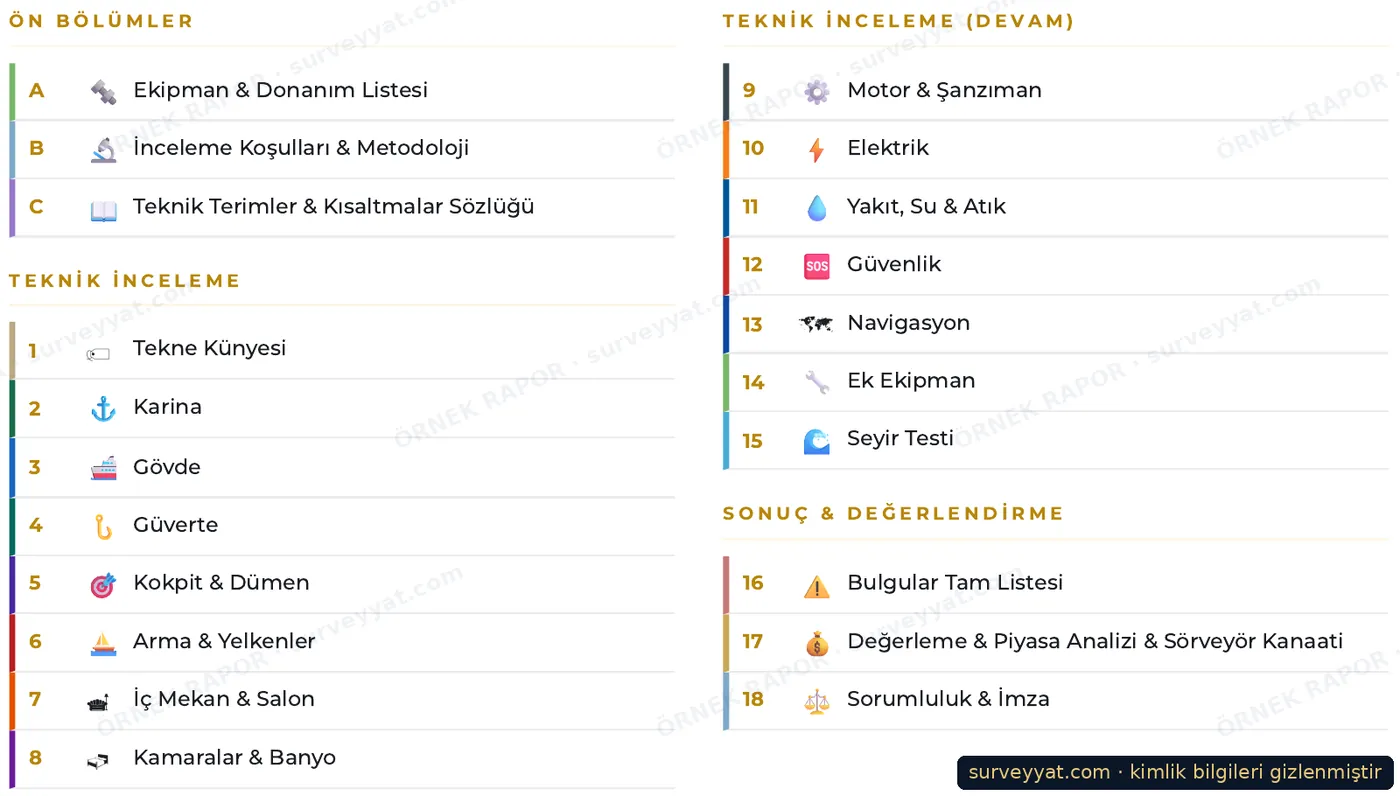
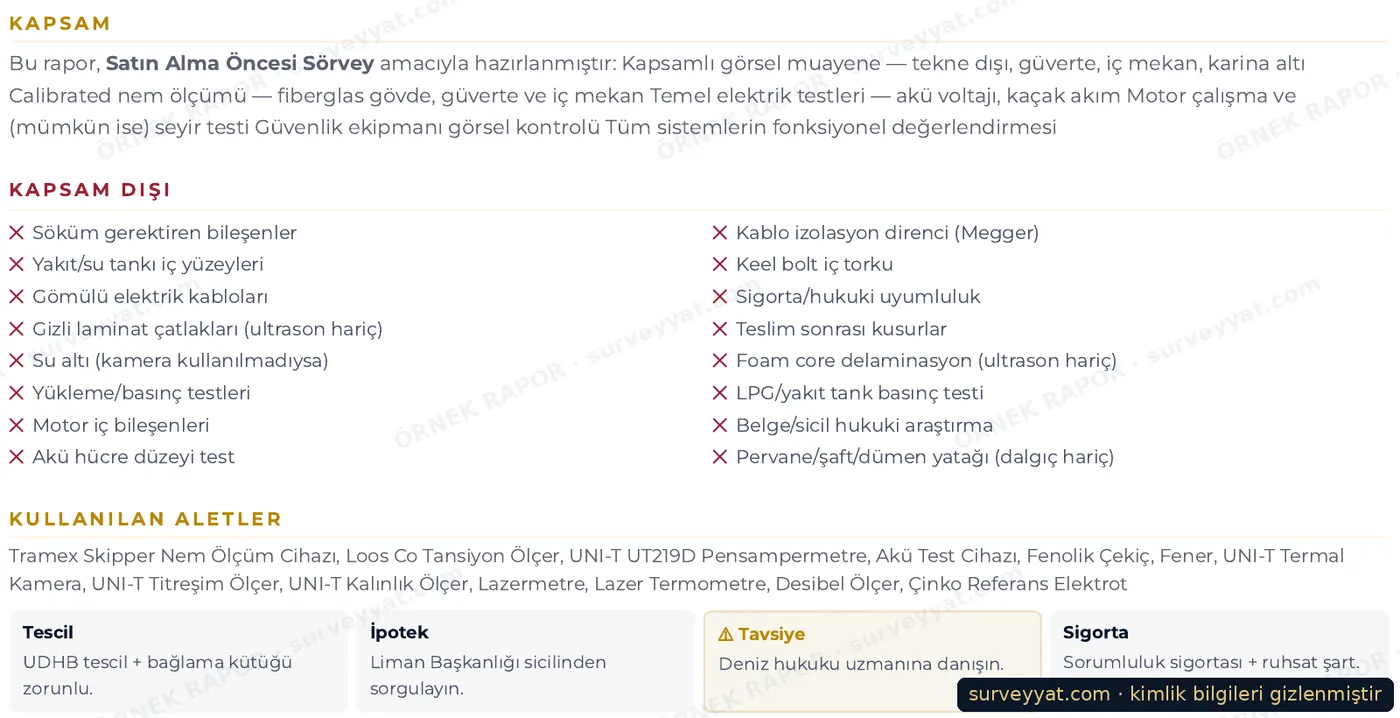
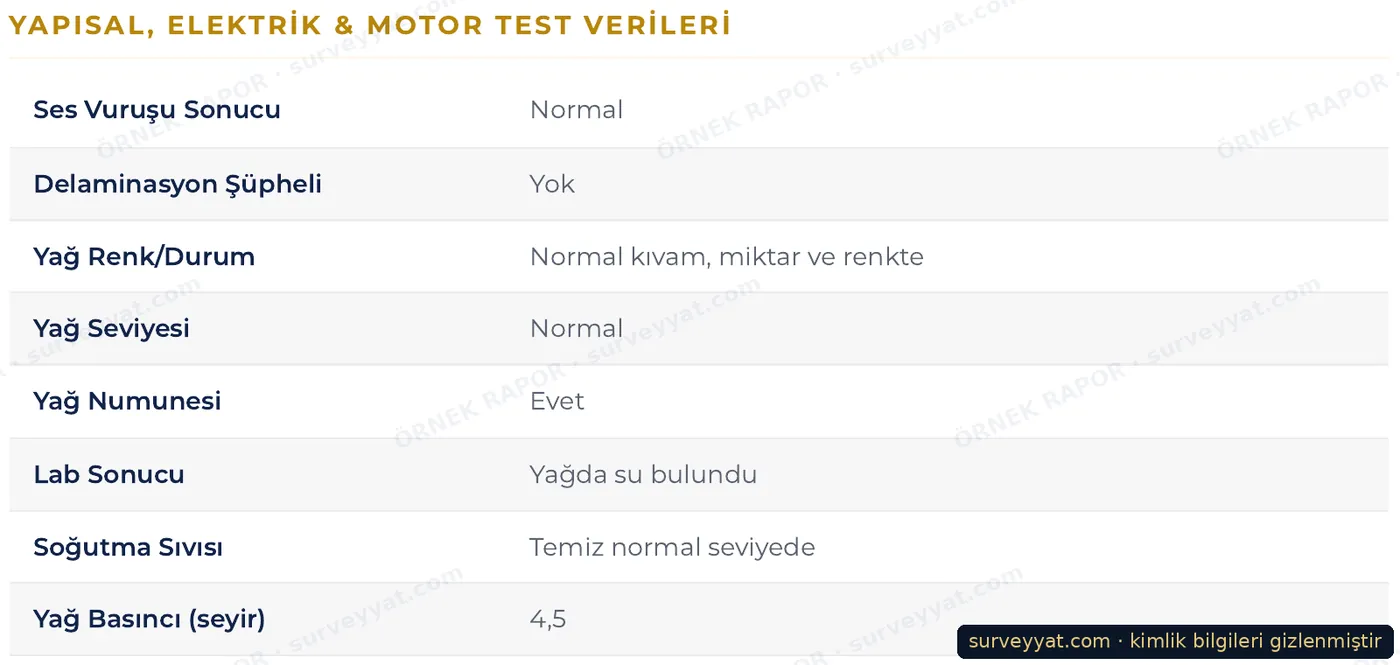
Taken from a real client report (96 pages, issued in Turkish). Boat name, make/model, report number, hull and engine numbers, place, date and people are withheld. More pages from the report
From the field: our measurements
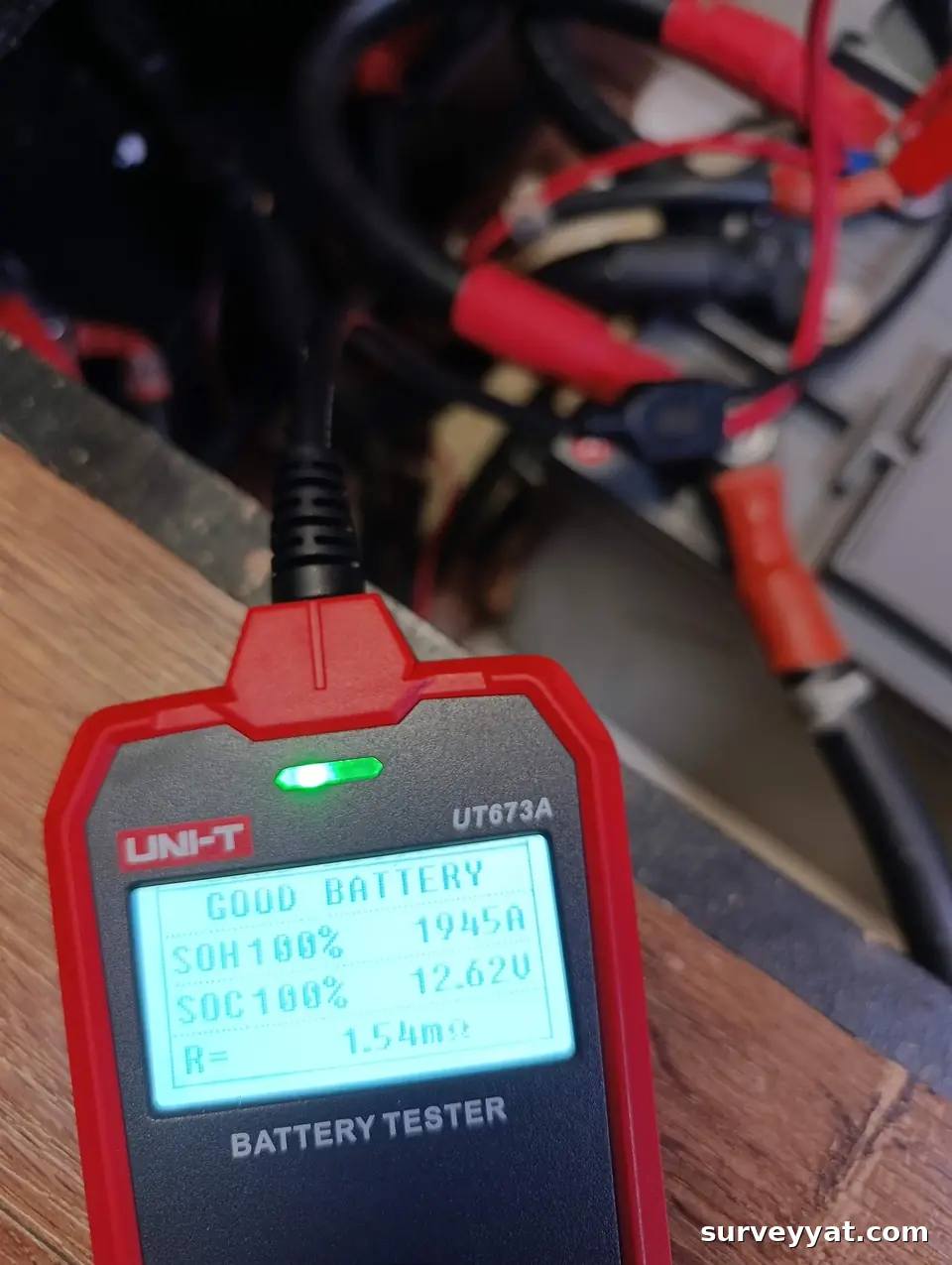
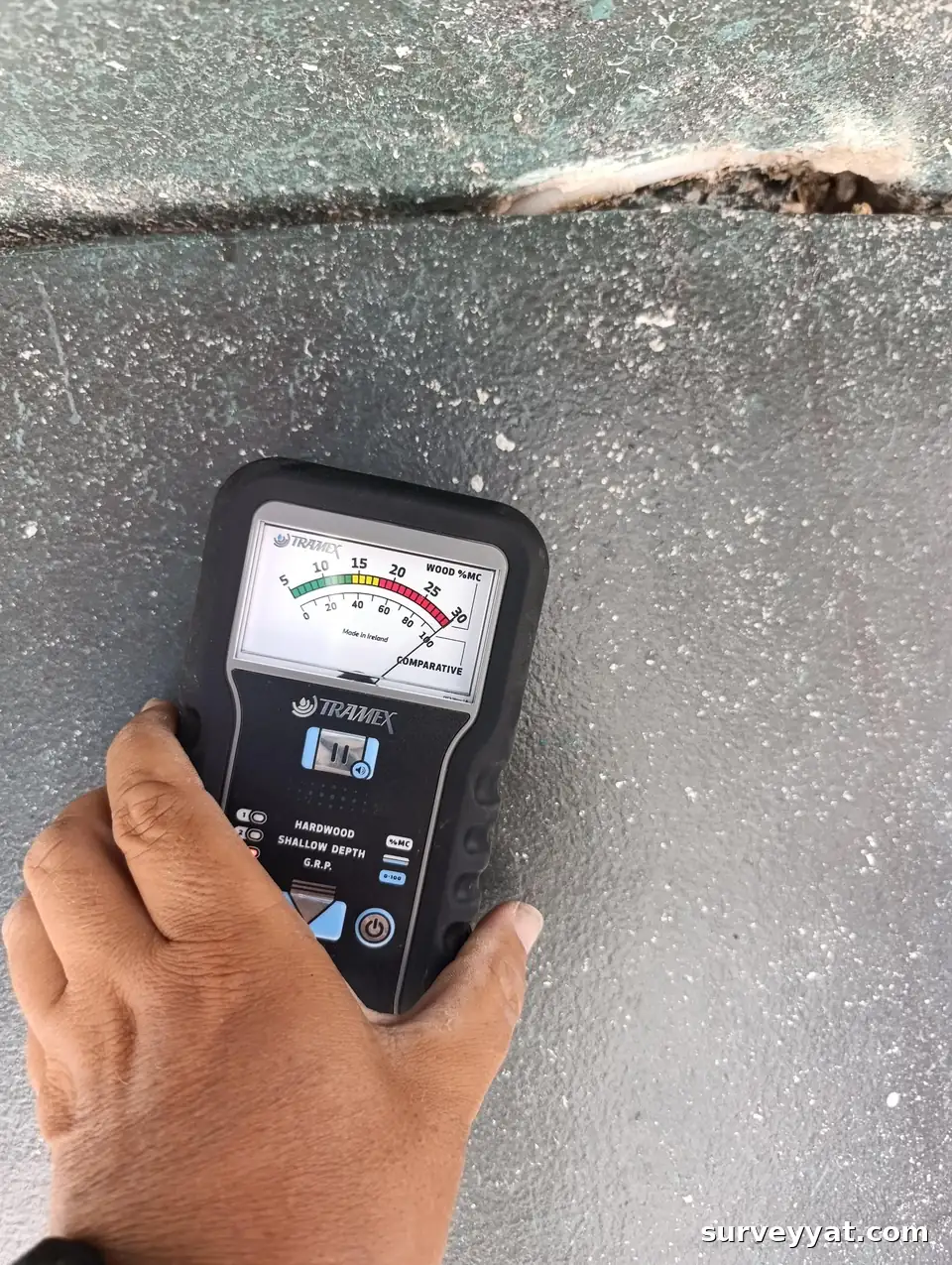
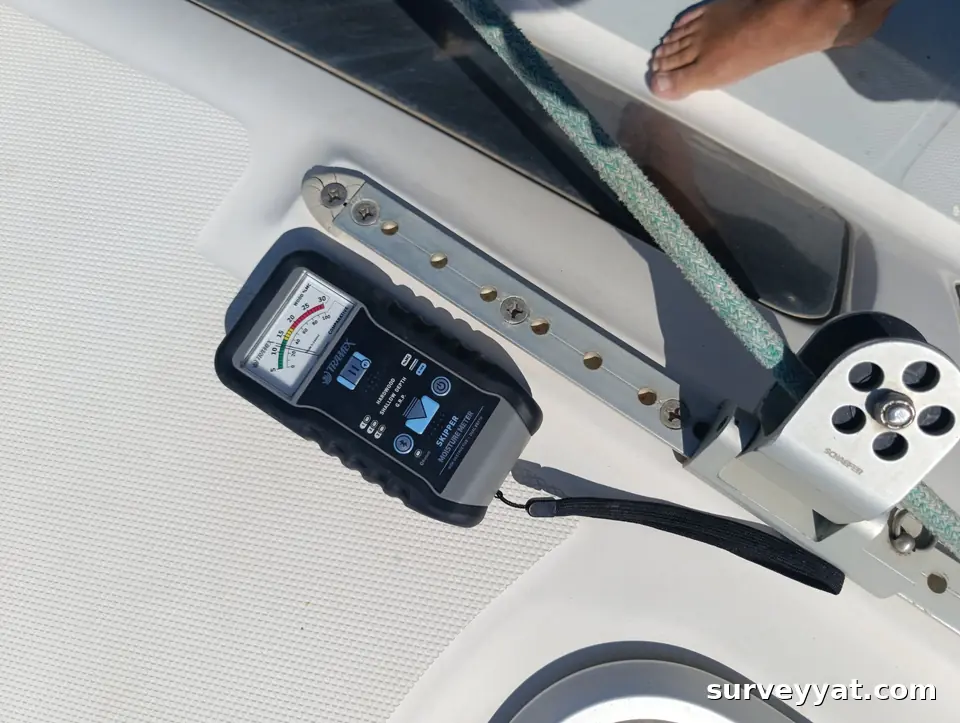
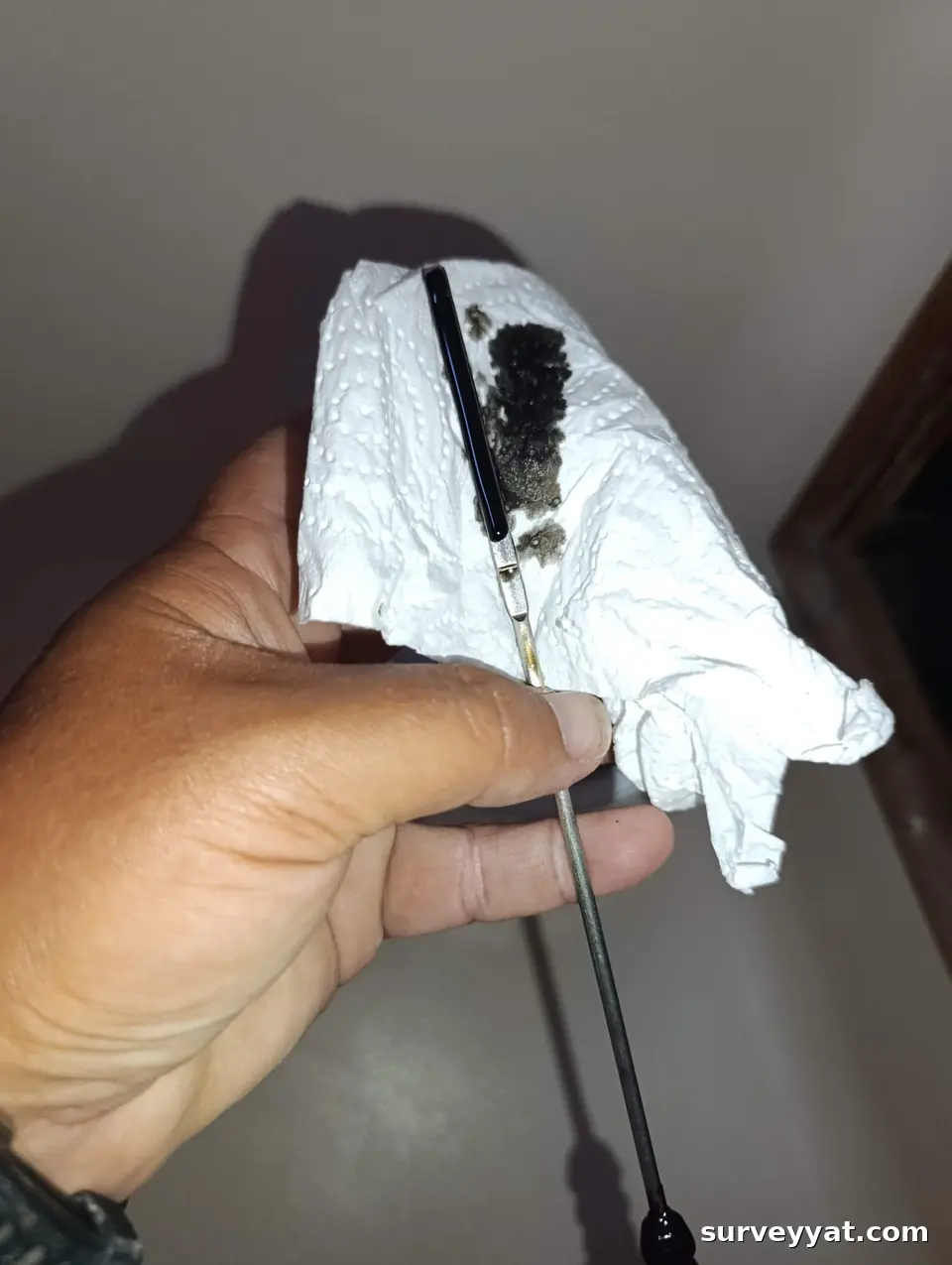
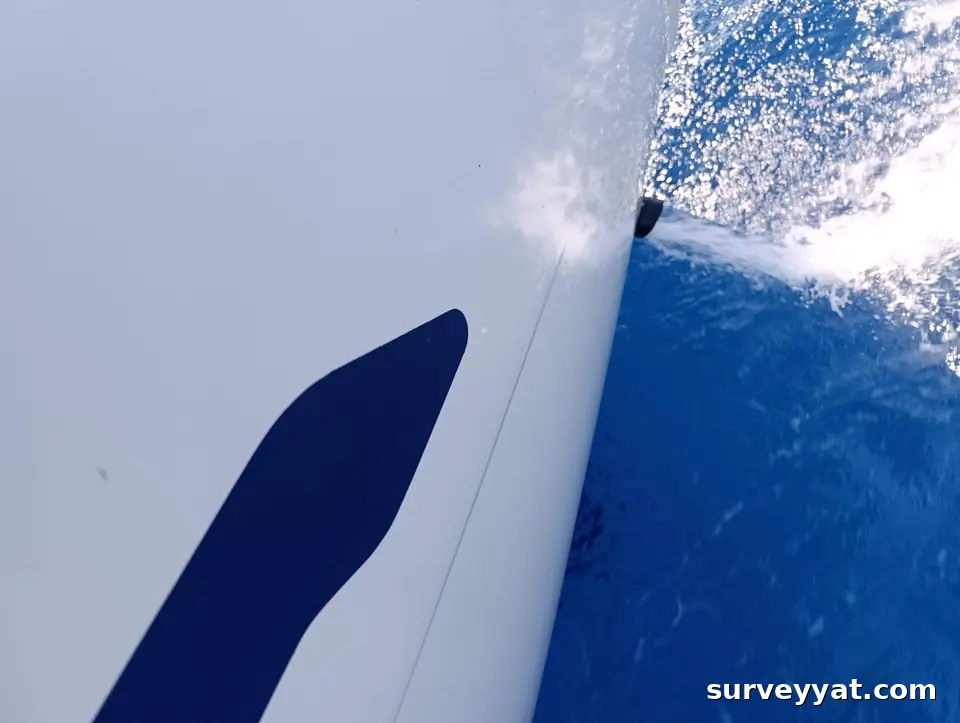
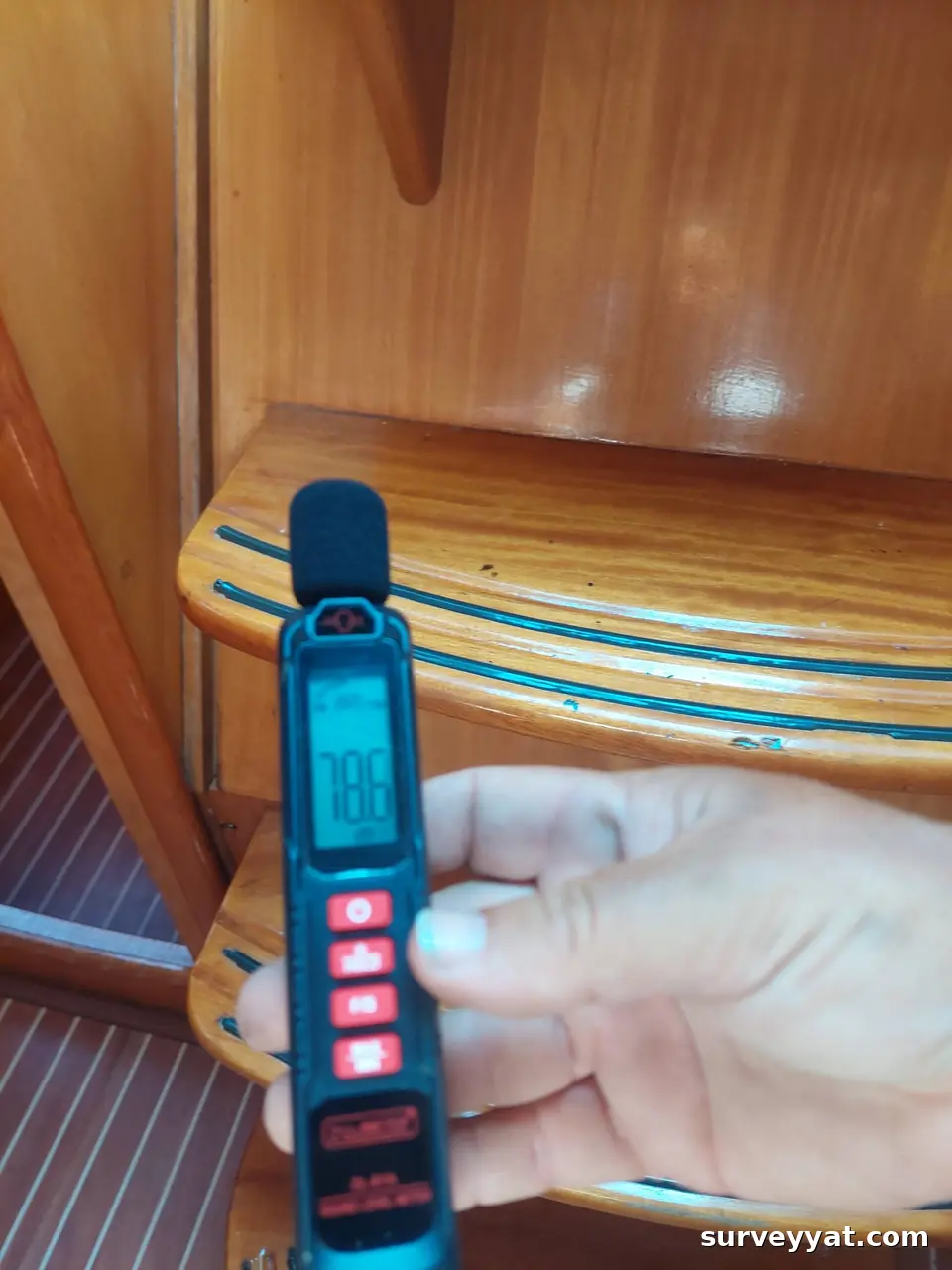
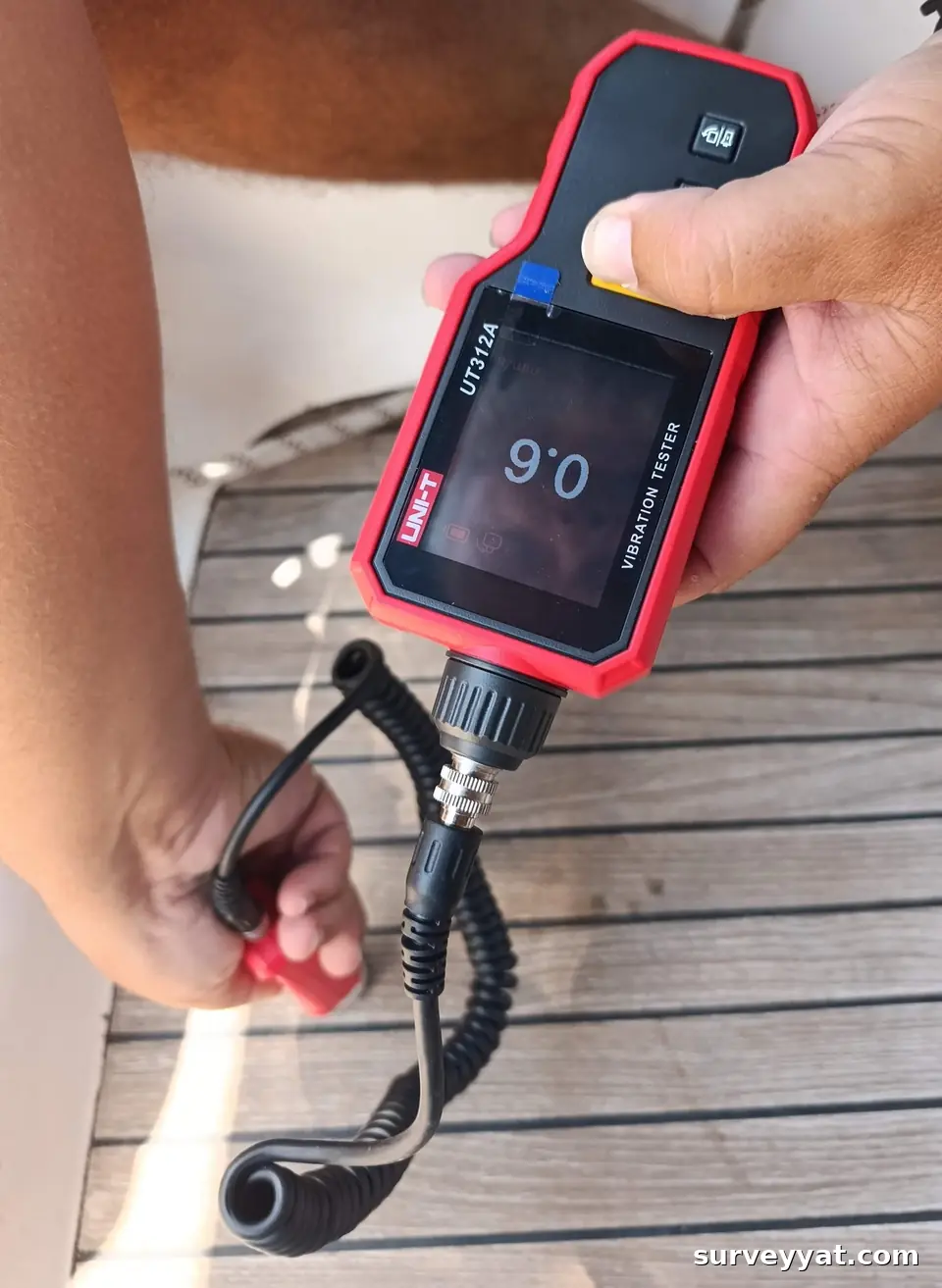
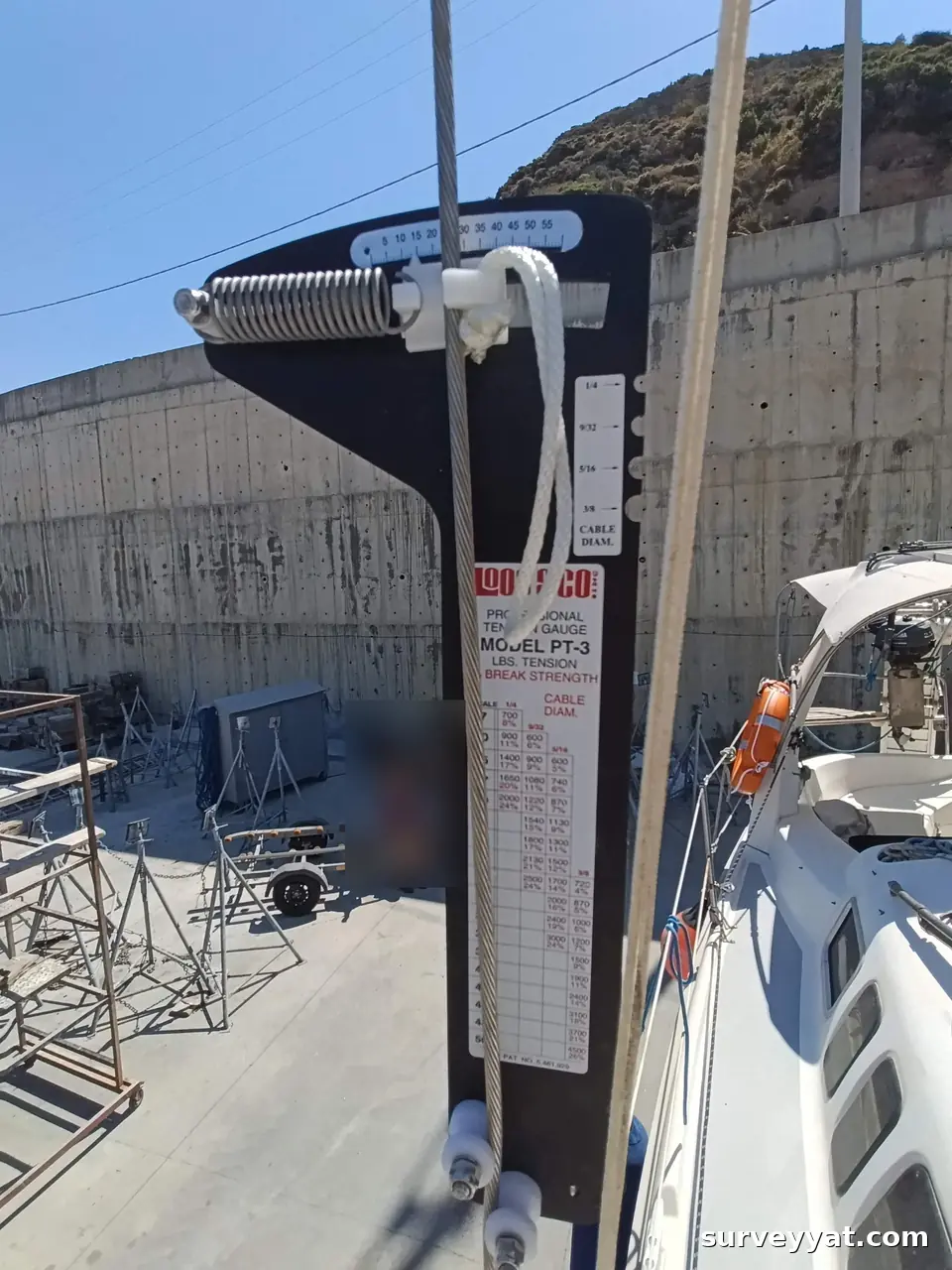
Photos from our own surveys; boats and people are not identified.
5. What This Example Should Tell You
- Findings are backed by numbers. Not "moisture is high" but "six points at 14-18% against the dry reference".
- Every finding is tied to a standard or a reason. That is what ends the argument.
- Positive findings are recorded too. "No structural defect", "readings consistent with reference" are part of a report's credibility.
- Costs are given as ranges, not quotations.
- Classification drives the decision. The class A total is the negotiation; class B is the first-season budget.
Frequently Asked Questions
6. Review the report format
The report format is set out section by section on this page.
Related Pages
Prepared by SurveyYat, ABYC Professional Member, 149 GT Yacht Captain. Last updated: September 2026.
Scope: The survey is non-destructive and nothing is dismantled; details on the survey types page.
Also in: Deutsch · Nederlands · Français · Русский · العربية