A good sea trial is planned before the day. If weather, fuel, the person helming, marina exit and the haul-out order are not settled in advance, the trial is either cut short or postponed.
Who does what?
- The boat's side
- The seller, or a skipper authorised by the seller, helms the boat. Fuel, marina exit and insurance are the boat's side.
- The buyer
- Can be aboard, and sees first-hand what matters to the decision.
- The surveyor
- Takes the readings, runs the tests and records the results for the report.
- Safety
- The safety decision before and during the trial rests with the captain. In unsuitable weather the trial moves to another day.
Weather
For a motor yacht, a calm or moderate sea is enough; wave height limits the full-throttle run. A sailing yacht needs a moderate breeze so sails and rig can be seen under load; in very sheltered bays the trial goes outside. The date is given with a second option based on the forecast.
Ashore first, or afloat first?
Either works. If the trial comes first, the boat is then hauled and the hull seen; moisture readings still wait at least a week of drying. If the inspection ashore comes first, the boat is trialled after relaunch. The choice follows the marina booking and the timetable; what matters is that both parts are done within the same survey.
The day before
- Keep the engine cold. It is not run before survey day.
- Enough fuel. For the full-throttle run and the return.
- Sails bent on. On a sailing yacht, main and genoa ready to use.
- Papers aboard. Registration, insurance and the skipper's licence.
- Time set aside. A sea trial usually takes 2-4 hours.
Scope: The survey is non-destructive and nothing is dismantled; details on the survey types page.
Choosing the test route
A route is chosen that reaches open water within half an hour of leaving harbour. A long full-throttle run needs an area with little traffic, enough depth and room to turn. On a sailing yacht, an area that gets the wind without being too sheltered is preferred. The route is agreed with the skipper beforehand, allowing for fishing nets, swimming areas and restricted zones.
Who is aboard?
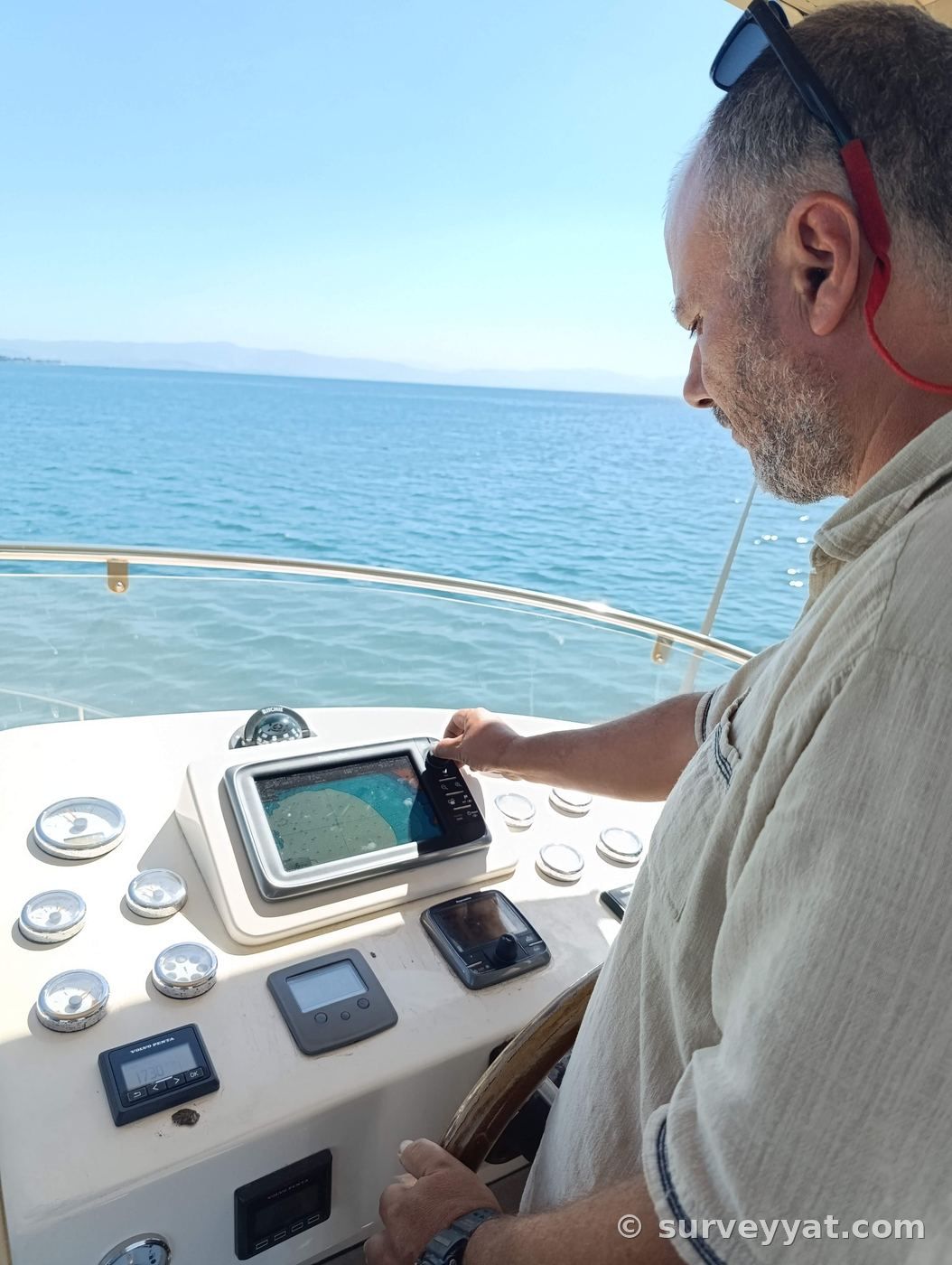
Aboard are the skipper handling the boat, the surveyor and, if they wish, the buyer. The seller or broker may also join. The number of people must not exceed the boat's design capacity, and everyone has a lifejacket. If an engine technician is coming for compression and blowby readings, those are usually taken in harbour before or after the trial.
If the weather turns
If the weather is unsuitable on the day, the trial is postponed. Inspection and readings ashore remain valid; only the sea trial moves to a new day. So when the survey date is set, a reserve day for the sea trial is discussed too. If the contract with the seller allows a tight survey period, it is written in from the start that a weather postponement extends it.
After the trial
Sea trial results appear in a separate section of the report, with the rpm table. A finding on the trial, such as not reaching rated rpm or a high temperature on one side, may call for an engine technician to look further. The report then states plainly which further check is recommended and why.